
A game about violence
Hotline Miami is a game about violence that's also a game about games about violence. It took the internet by storm in the fall of 2012, winning hearts, minds and a decent bit of ire with its hypnotic soundtrack, retro graphics, and truly gratifying and horrific video game violence; along with the simultaneous, implicit commentary it provided on violence and narrative in video games.
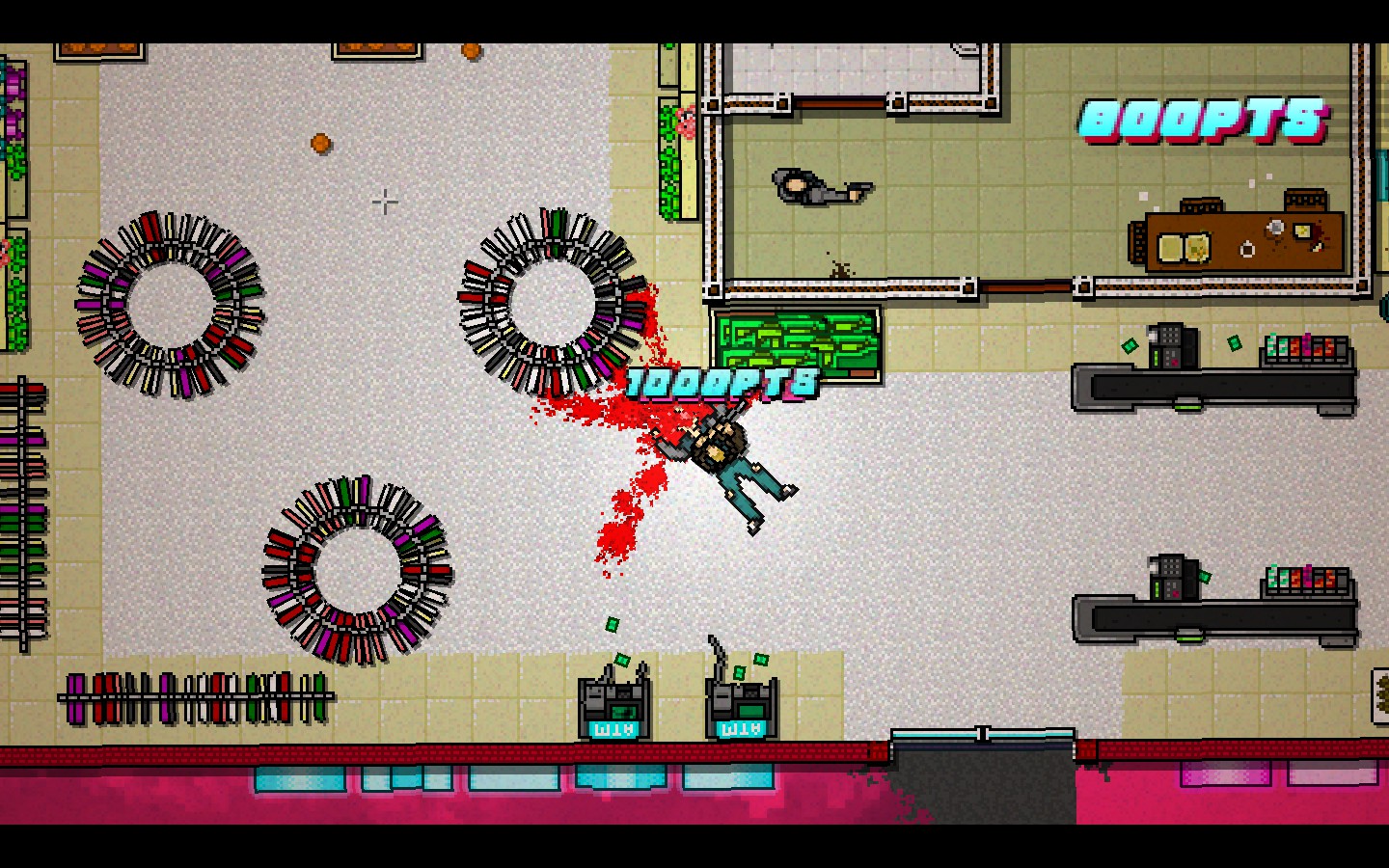
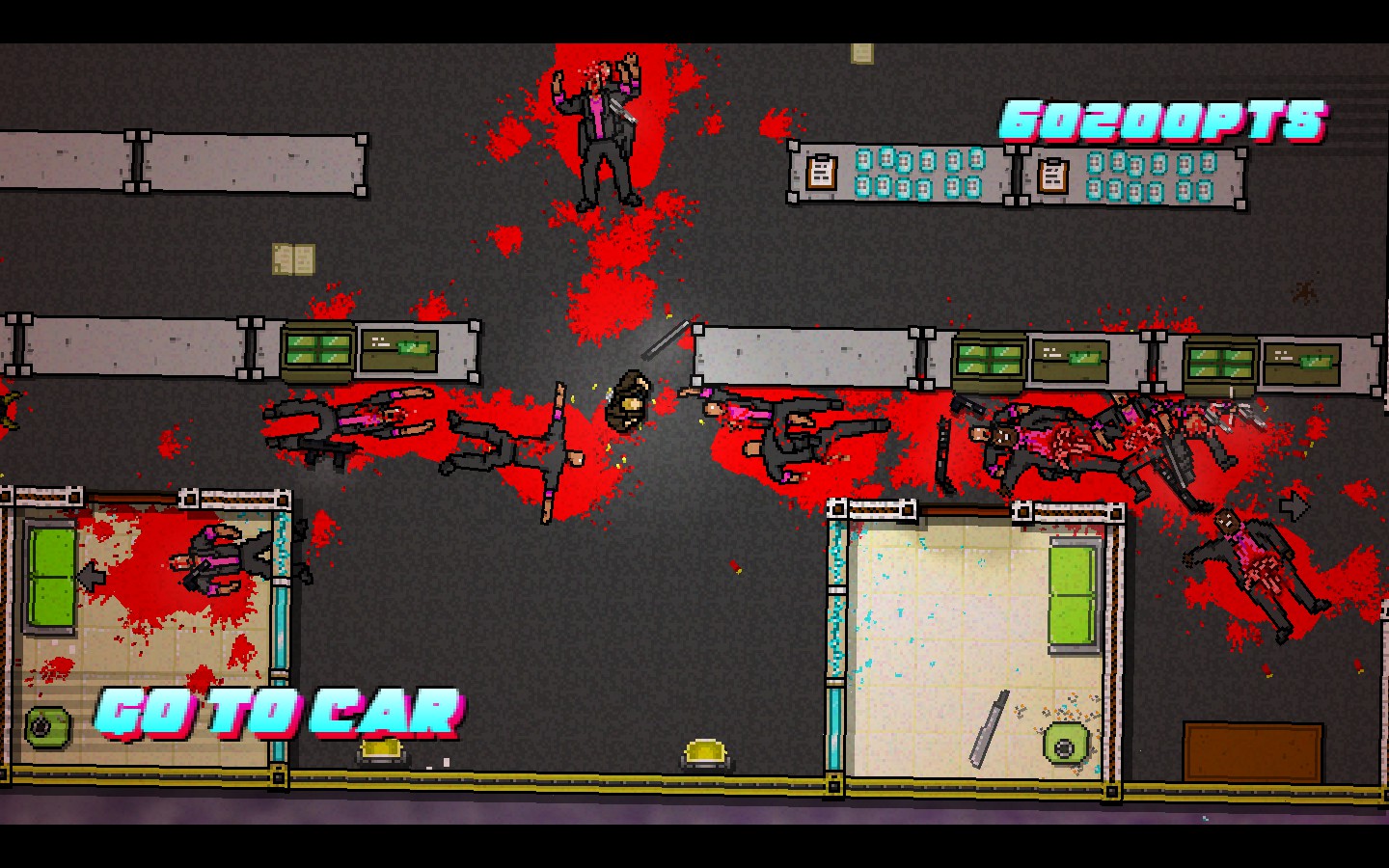
Hotline Miami is a top-down game with graphics reminiscent of the original Grand Theft Auto. It is a game about violently killing violent men in a given set of rooms, as quickly as you can. It is a game about points. It is a game about combos. It is a game about rushing from room to room, using whatever you can lay your hands on to beat, shoot, or otherwise mangle to death every person foolish enough to get between you and the next person- you and the last person. It's a game about all of those things; until it isn't. Once you kill that last person the music ends, the flashing scores and combo counters disappear. Then it's a game about walking back to the car when you're done. It's a game about the bodies smeared across the floors and splattered against the walls.
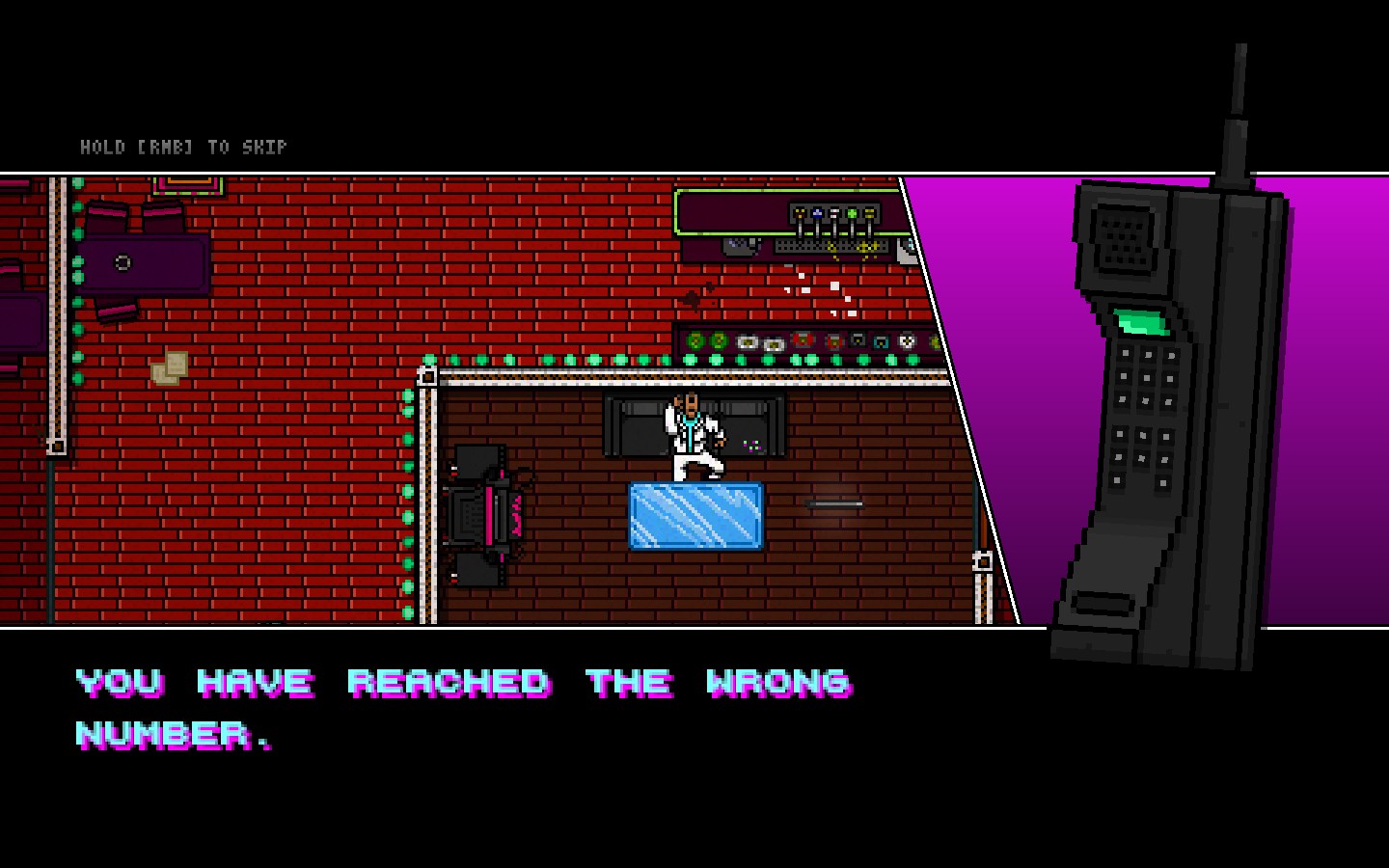
Though incredibly effective, the gameplay and storytelling in Hotline Miami generally follow a pretty stable formula. You play as a man known only as Jacket. Every mission begins with you receiving a cryptic phone-call, always being given an address and a request to be "discrete." The levels begin in earnest when you arrive at the address, don an animal mask of your choice (with each one granting a different perk or ability) and proceed to slaughter every person present, generally being members of the Russian mafia.
The game is punishingly difficult, with every scenario trying your ability to perfectly address every enemy on the screen without ever being hit. Dying and retrying is fine-tuned for minimal latency, one click and you're back in, reflexively running, swinging, shooting and throwing, dying and living again until you find the right pattern and execute it perfectly; until you achieve a perfect spiraling dance of death, leaving your character unscathed and surrounded by broken bodies when the music ends.
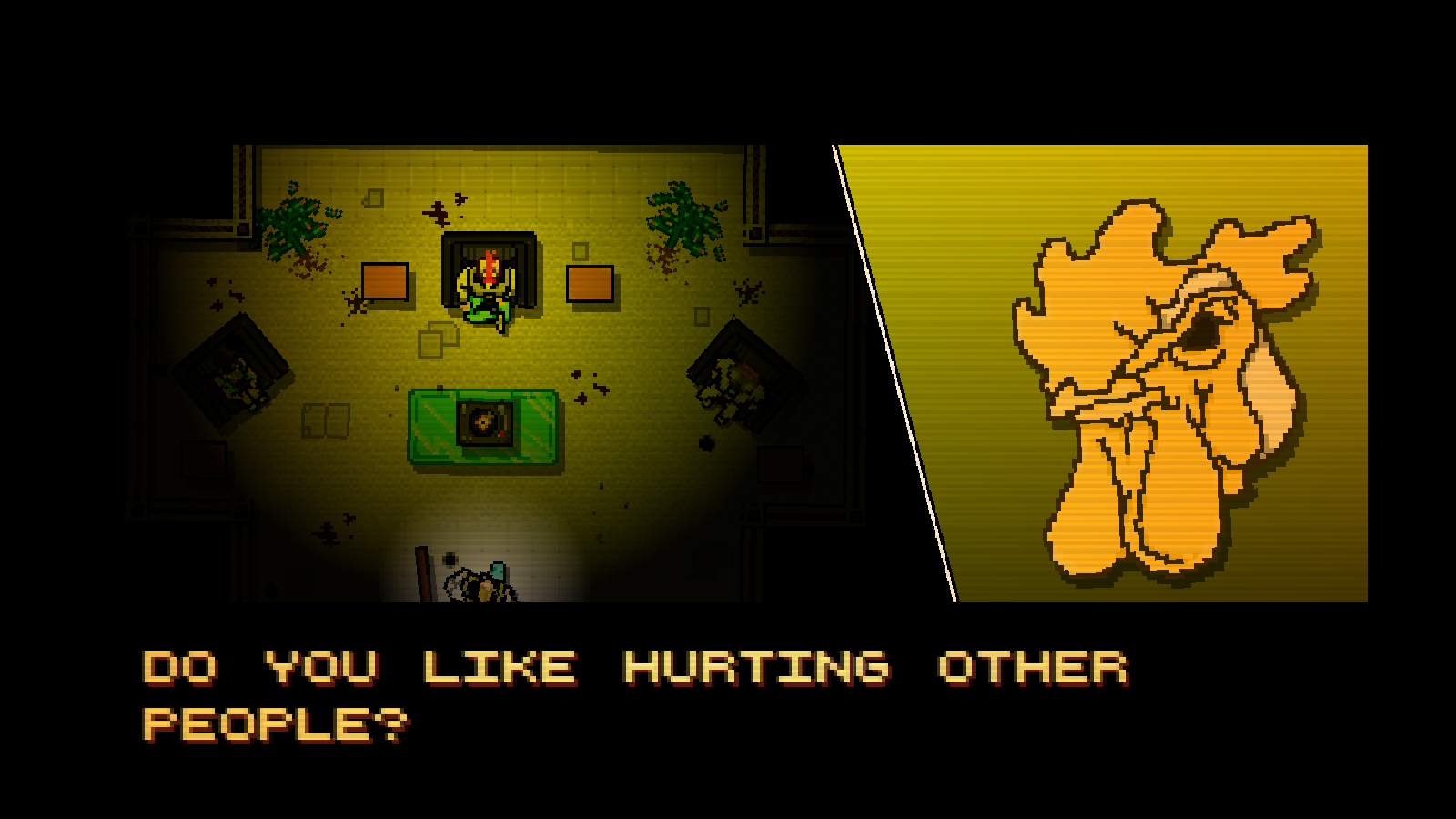
The game encourages brutal efficiency, keeping the tempo high with score rewards and an unbeatable soundtrack. Combos are awarded with big, pretty graphics that seem to pulse with the music and violence both. Hotline Miami is a very addictive play experience, but more importantly it isn't afraid to ask, through its narrative and presentation, why you're addicted to it. Do you like hurting other people?
Since the controversial rise of the first game to the status of indie royalty, a sequel has been anticipated and the ensuing controversies surrounding its announcement trailer and convention showings have only stoked that anticipation more. With the first game so defined by a shock, a "feel," a few core game mechanics and a vaguely sketched-in, seemingly duplicitous story, was it possible a sequel could ever live up to its legacy?
Bigger, louder, stranger
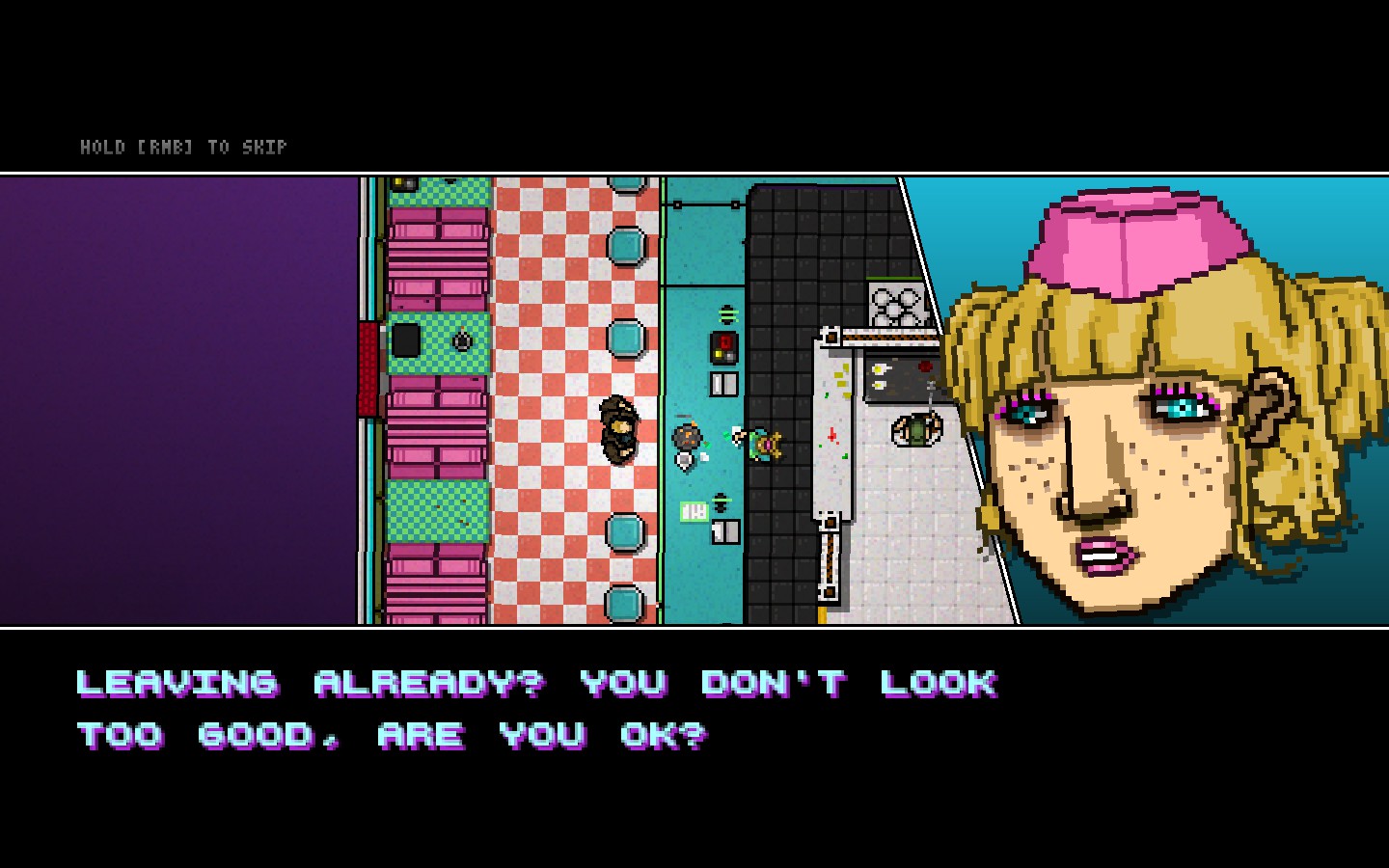
Visually, Hotline Miami 2 could be accurately described as Hotline Miami, only more-so. This is not faint praise. Though the success of Hotline Miami was certainly due to a confluence of factors, the way its dated graphics perfectly captured a tone and an era was a nearly universal talking point. Hotline Miami 2 doesn't mess with a working formula, sticking with the same graphical feel of the original but doubling down on content.
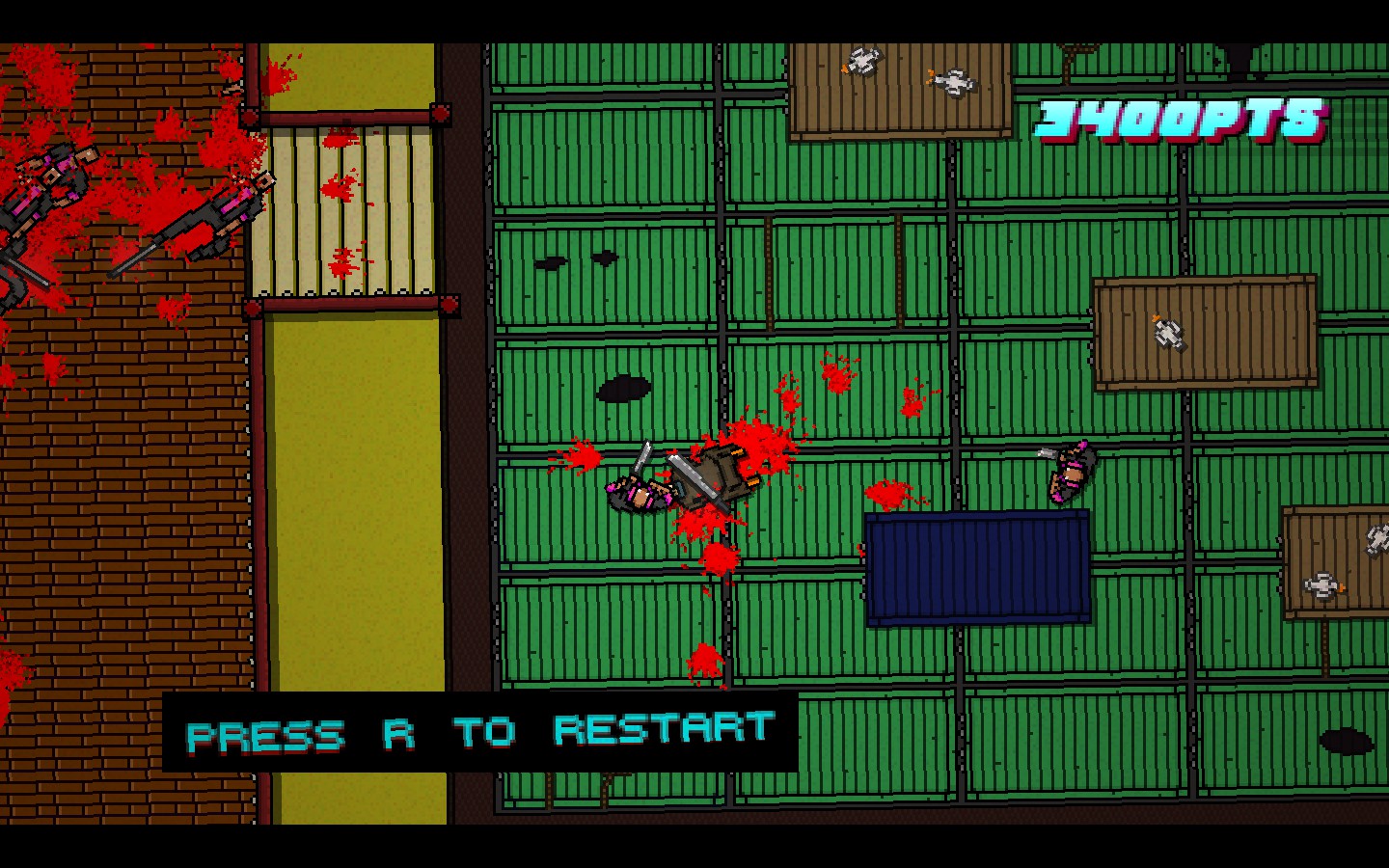
The violence has the same satisfyingly squishy viscerality of the original, with the bodies breaking in enough various new ways to keep things sufficiently fresh and gross for another go 'round. The game environments are congruent in style but much more varied than the first game. Levels have a far greater tendency toward sprawling impressiveness, but the familiar attention to detail is everywhere, making the areas you traverse look actually lived-in before you fill them with death.
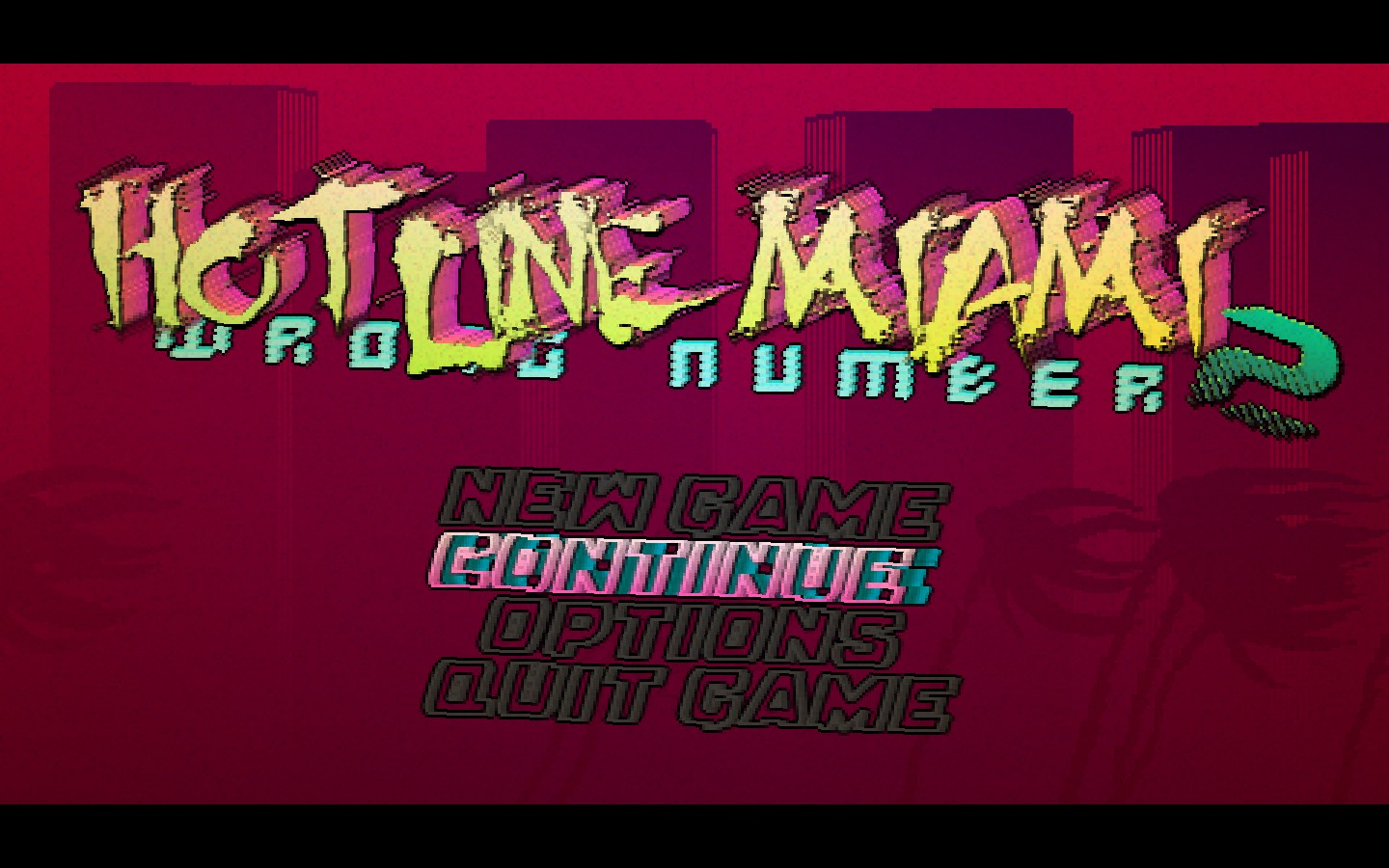
Even the menus and score-count screens can't let you down, straight-up callbacks to the overly satisfying framing elements of the original; filled with even more glorious 80s-infused pixels and effects-drenched, downtempo music. I spent my first 5 minutes with the game marveling at the main menu, unwilling to go on if that meant stopping the music; ending the feeling.
Speaking of the game's soundtrack, it is impeccable. Just like the first game, the music often feels like the real driver in your killing sprees. The pumping, danceable melodies imbue every shot and life-ending collision with rhythm; the visual cues bleed into the music, the constant retrying echoes the looping of the unending, nerve-bending techno. Even in the game's longest, most difficult levels I never felt tired of a song before the last body hit the floor and the music ended.
All that said, I do have to admit that none of the melodies got stuck in my head the way MOON's contributions to the original soundtrack did. The songs that stuck with me best from the sequel were actually some of the slower, more experimental material that accompanied the game's greatly expanded expositional sequences. Maybe it's a testament to the greater attention given to the game's story that these were the songs looping in my head at the end of my spree.
The answers behind the masks
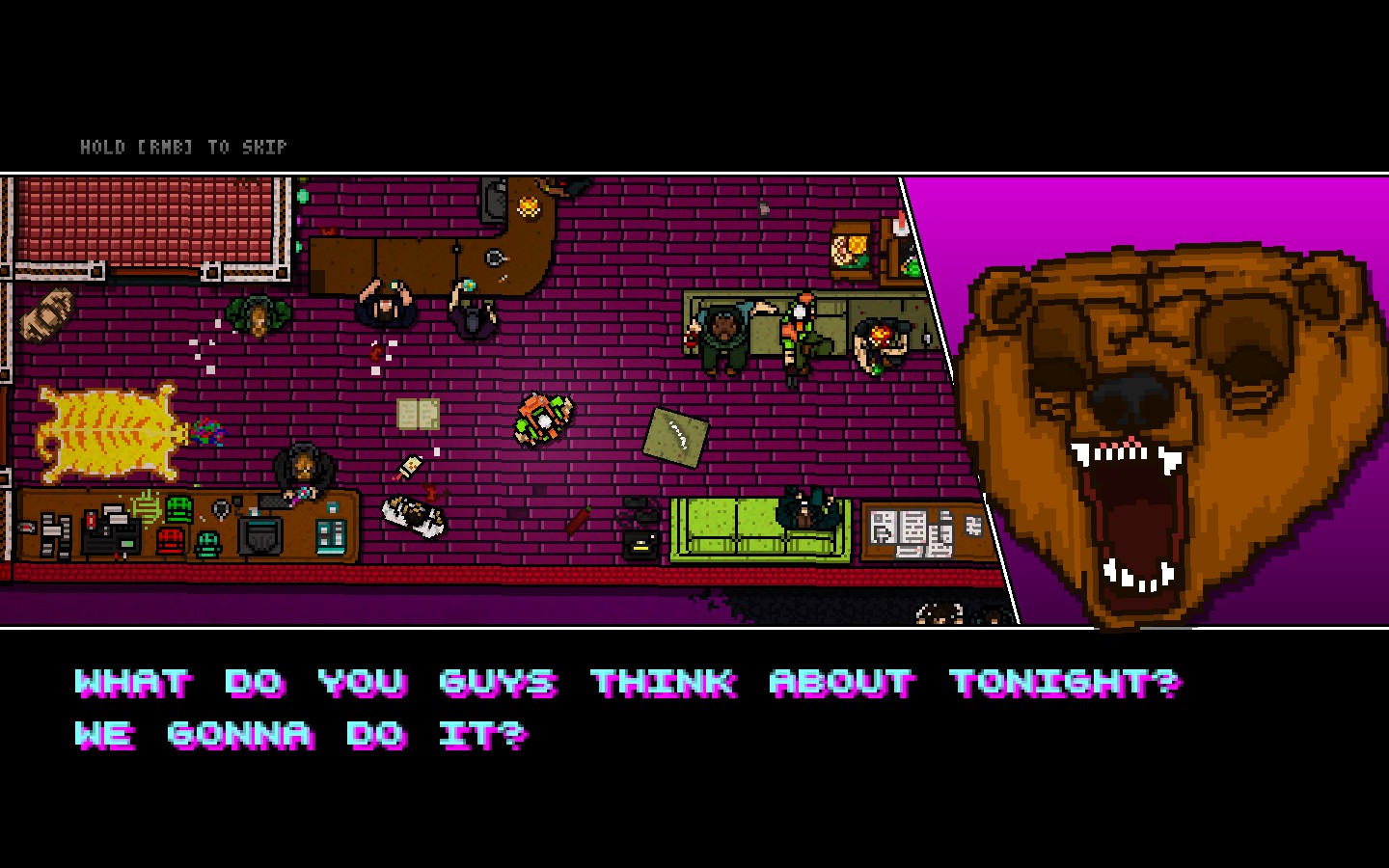
The storyline is a greatly expanded element in Hotline Miami 2, but it's worth noting that it will likely be extremely hard to follow if you haven't played the first game recently, and even then piecing it all together might take some effort. Gone are the formulaic intros of the original game, with the player instead dividing their attention among several intertwining storylines, each with their own playable characters. Instead of selecting a different mask for each mission players are usually asked to choose between characters, although some storylines make a return to the masks and others omit any choice of playstyle entirely.
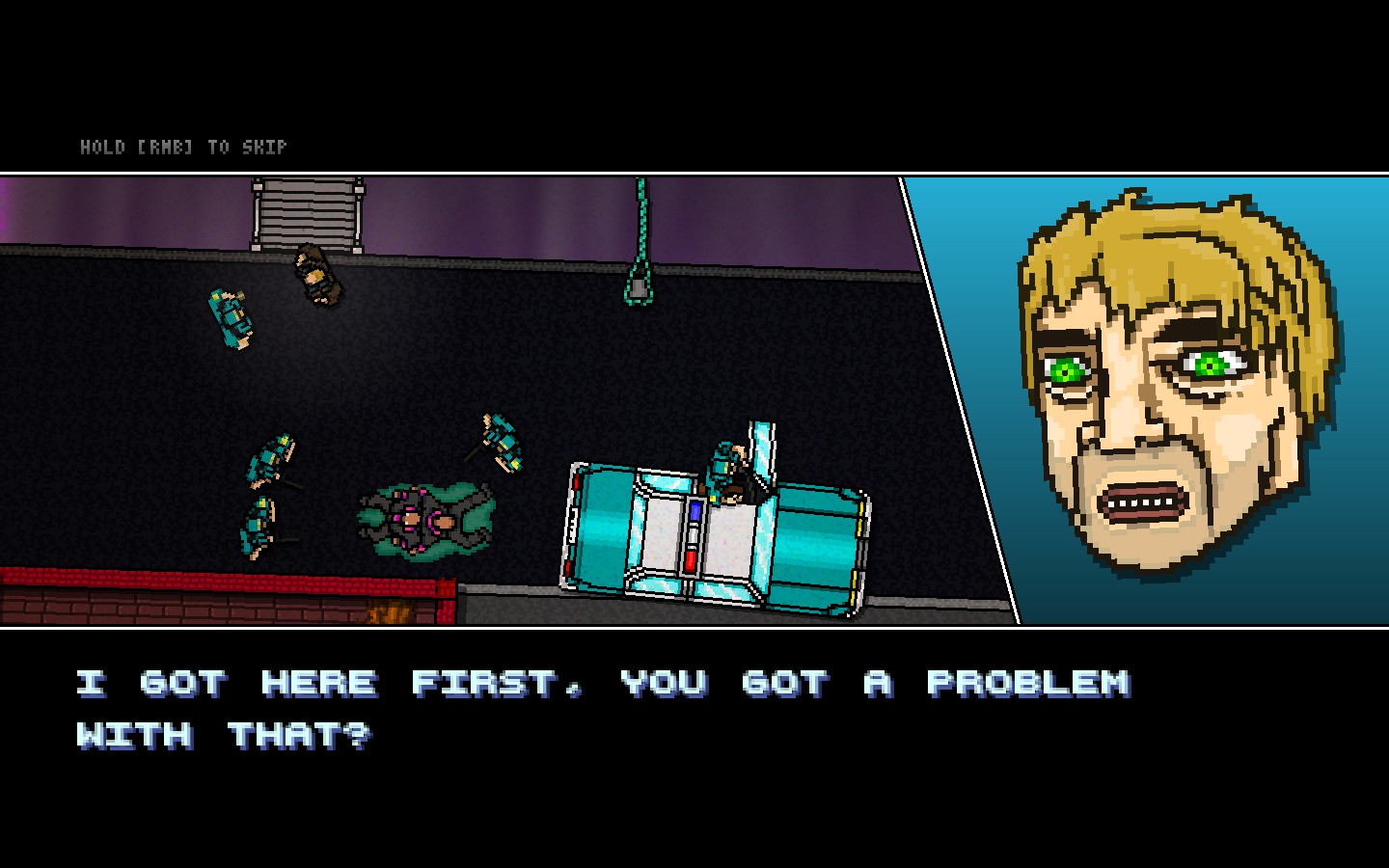
The stages are often presented non-chronologically, dividing the player's time between events before and after the original Hotline Miami. The more diverse viewpoints give the game a much better opportunity to flesh out its world, and it takes full advantage. The player takes control of a range of characters, including one of the dead masked men you could find in the original game, an elite squad of soldiers fighting a Russian invasion of Hawaii in 1985, a group of fans of the original game's killer who have become full-blown copycats, and a hard-boiled detective who uses his badge to shield him from his own misdeeds.
One of the most disturbing elements of the original game was the realization, somewhere along the way, that the game might be addressing you, the player. Along with the eery effect of walking past all the carnage at the end of each level, the subsequent cutscenes often seemed to be advancing a dialogue with the player as much as the game's story. These scenes often seemed most poignant when you were subjected to the voices in Jacket's head, animal-masked hallucinations that seemed inextricably tied to the phone calls and Jacket's undoubtedly troubled past. Far beyond babbling clichés of insanity, their accusatory probing often seemed as relevant to the player's fascination with violence as the player-character's.
This secondary meta-narrative peaks at the end of the first game in an unlockable scene where the player encounters a pair of mysterious figures apparently key in orchestrating the game's events. On close reading, the dialogue from these characters can be read as a rather direct message from the game's creators. As the player's character demands answers, a reason for all the violence, they directly call into question the value or necessity for any. After all, this was about doing something you enjoy, wasn't it?
This element of the narrative is mostly dropped in sequel, although it's not hard to see the "Fans" set of player characters as a new stand-in for the game's appraisal of its audience. Richard, the first game's chicken-masked harbinger of doom, makes his return in much the same role as the first game, but he doesn't talk to us anymore; the voices are only in the characters' heads now.
It's easy to see why this decision was made, since the second game seems intent on providing all the answers the first game was so reluctant to. With all the new back story and exposition, the idea of winding it all up into double narrative is exhausting just to consider, as is the thought of trying to unravel it all. Still, it's hard not to miss this element; not only did it add a dimension to the game but with so many of the first game's questions left to be answered by the second game, this secondary non-story seemed better fleshed-out than the actual plot. However, the second game does an admirable job of answering all the questions the first game left us with, and the answers it gives by the end truly do feel satisfying. Not only do details revealed in the second game make the revelations of the first more meaningful, the much more ambitious storytelling serves as a refutation to its conclusions: the reasons behind all the violence are compelling to the end and unraveling them is often as enjoyable as enacting the violence itself.
When bigger isn’t always better
Unfortunately, as much as they expand its emotional capacity, the game's ambitions often butt up against the realities of its core gameplay, and in its worst moments it seems that the higher aspirations of the sequel are hamstrung by the higher aspirations of the sequel. Many of the changes incurred by the game's more grandiose scope and narrative style fly in the face of what made the first game play so well.
The narrative mechanic of switching characters works brilliantly for the game's storytelling and atmosphere, but in terms of actual gameplay it means more limited options for each level than the original game, where your collection of masks and accompanying abilities was always growing. With every unlocked mask usable on almost every level, it guaranteed a fresh experience for extensive replaying of beaten stages. In Hotline Miami 2 you are only ever granted a handful of options for each mission, and that's on the stages where you get to choose at all.
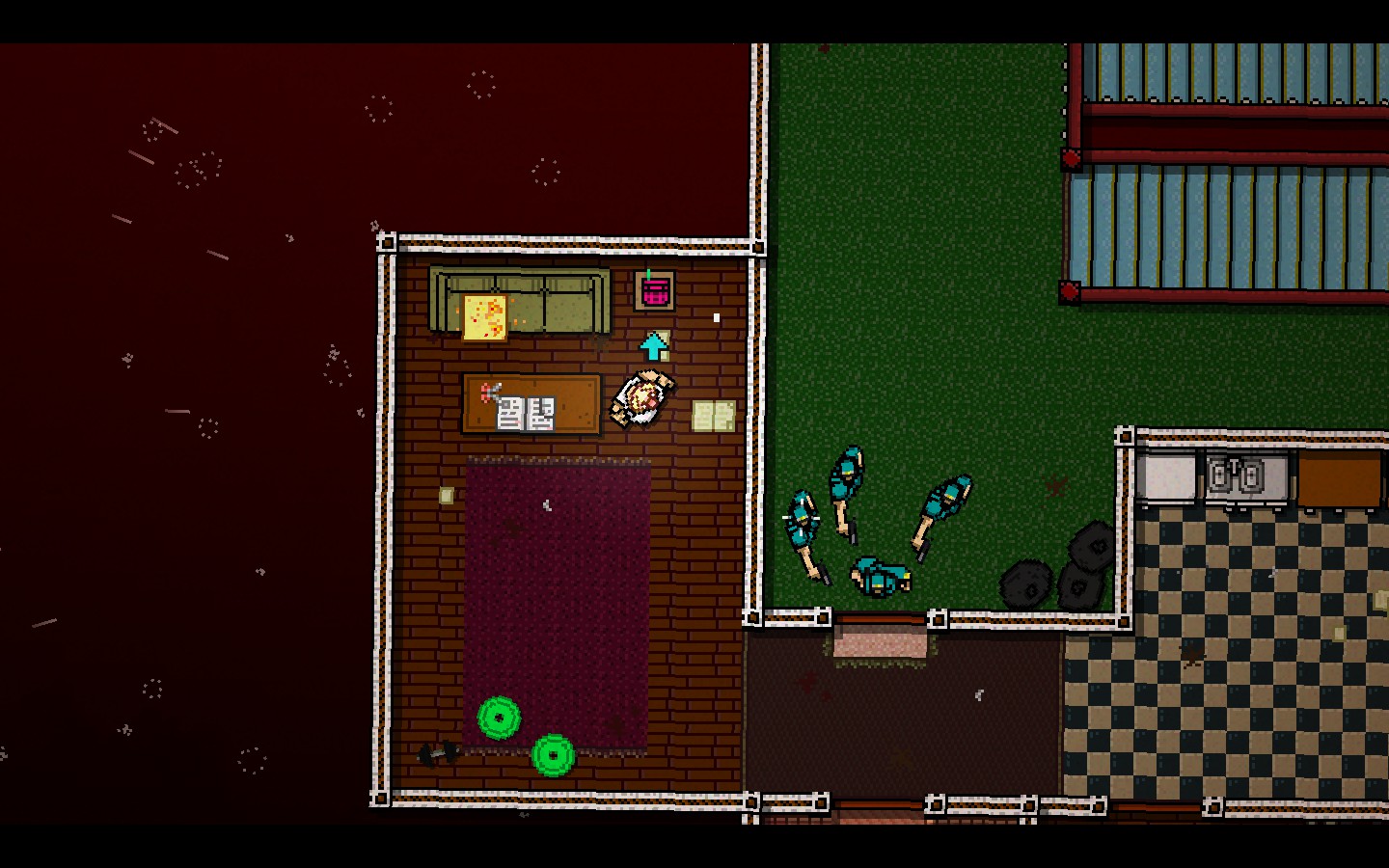
While the abilities you are granted are more varied in Hotline Miami 2, they also tended to be more forgettable and useless, at least to me. There were several abilities in the game that I only ever used once, on stages where only that character could be used and the environments were clearly contrived to make their abilities necessary. I quickly found that the wide variance and limited options in the sequel meant that out of each group of choices there was really only one character I enjoyed playing with.
The most frustrating change to gameplay, however, is the increased ambition of the level designs. After the first few stages it seems that every area you clear in Hotline Miami 2 dwarfs the largest of its predecessor. While visually impressive, these larger areas frequently lead to the most annoying occurrence in the game: being shot by an offscreen enemy you had no way of seeing. The increased size and population of the stages means more time spent dying over-and-over before you reach the next blessed checkpoint. A pattern that rarely felt frustrating in the original can quickly become tedious when you're killed repeatedly by an offscreen shooter after dropping 30 or so of his easier-to-see friends over the course of five-minute-plus runs.
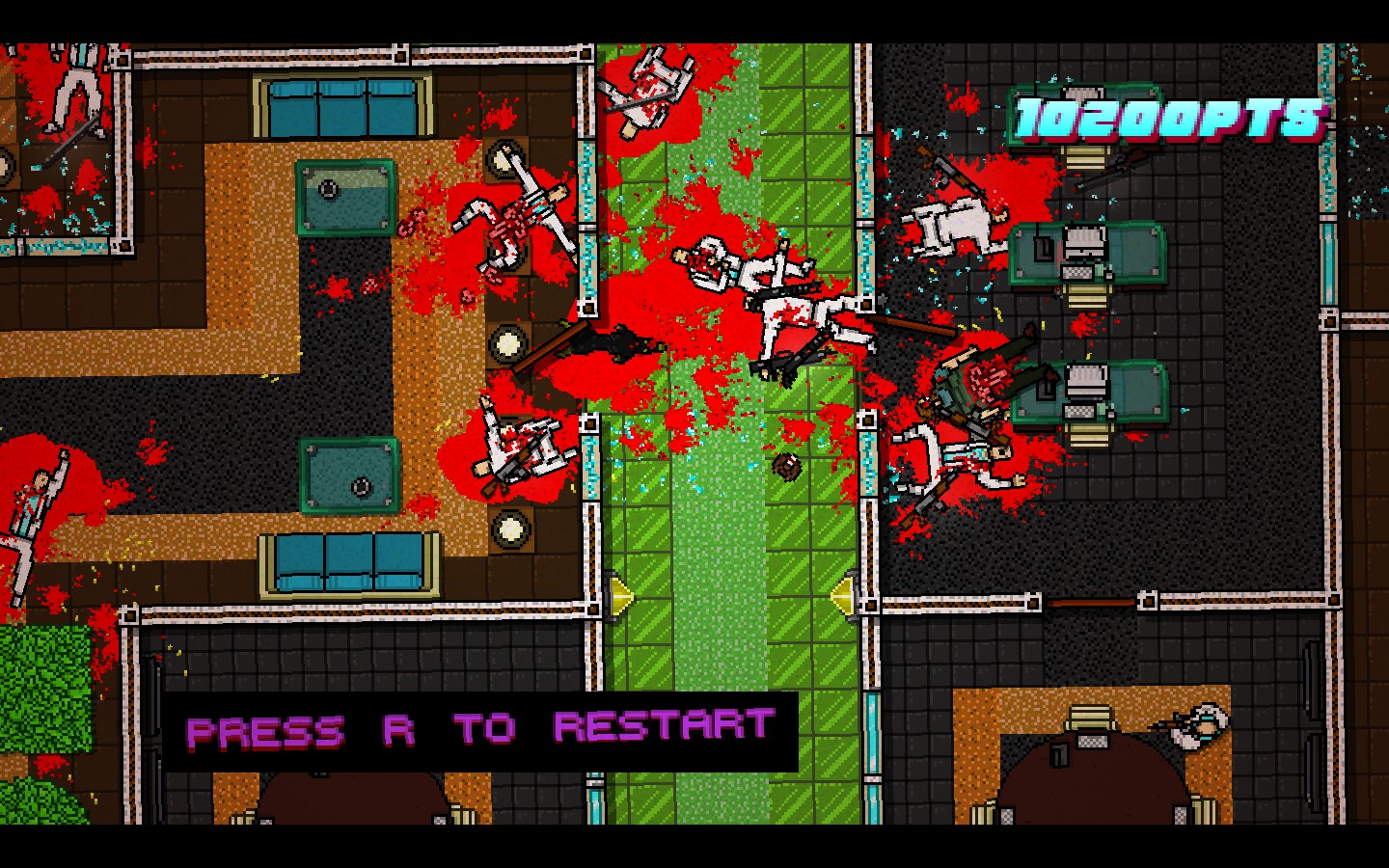
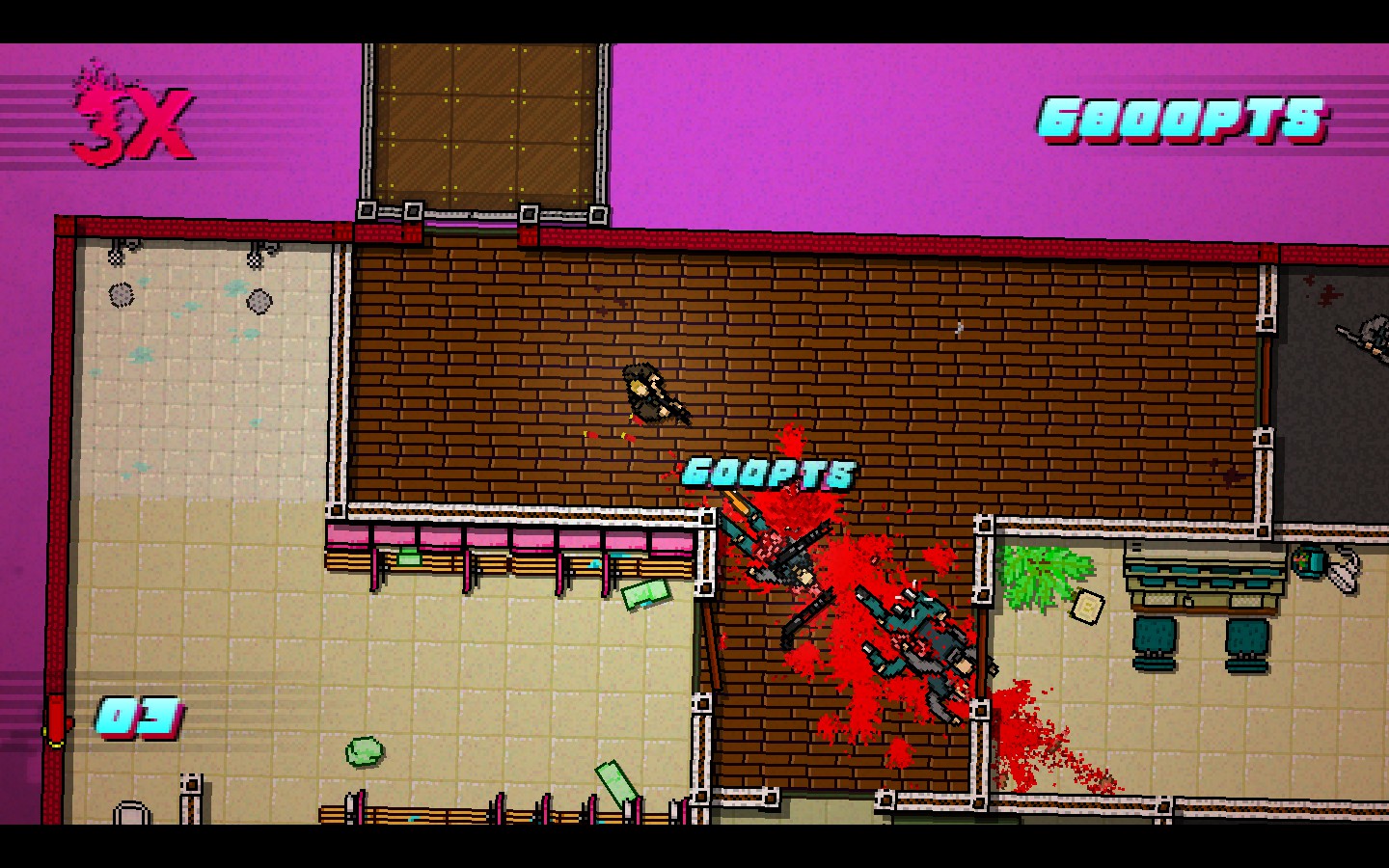
The larger levels make gunplay a more prominent element of combat in Hotline Miami 2, but the game really isn't doing itself any favors here. Intelligent gunplay doesn't lend itself to combo-rushes the same way literally rushing through enemies with a lead pipe or katana does, and the game's predictable AI doesn't help the gunplay much either. All too frequently it seems firing your weapon near a doorway and taking down the ensuing bottle-necked swarm of enemies is the only reliable way forward. Find a new gun on one of the bodies, rinse, repeat.
Where the first game had me constantly rushing for combos, taking risks to increase my score and the fluidity of my violence, the sequel's longer levels encourage a more cautious gameplay. I found myself much more frequently taking advantage of bottlenecks and shooting around corners, scoring combos all at once with carefully timed sprays of bullets. Most importantly, every death took a little longer to reach and set me back a little bit farther than the original. Every mistake felt a little more frustrating, every accident a little more grating than the original. The challenge and the narrative certainly feel bigger in Hotline Miami 2, but unfortunately so do all of the little failures it takes to traverse them.
A fitting conclusion
Sadly, even the expanded narrative suffers from its expanse. Much longer than the original and told out of sequence, the story often feels even harder to follow. Important details are everywhere, but often left to be intuited by players or caught in fleeting moments during cutscenes. Because the game is difficult if not impossible to beat without several gaming sessions it will be hard to remember the relevant clues as the storylines all spiral toward their inevitable conclusion. That conclusion, it's worth mentioning, is fantastic, giving new weight to Jacket's saga in the first game and offering the conclusive final say on every story arch across the two games. Like the first game, it has already spawned much dissection and discussion online, so for anyone confused at the end of the game the instruments of clarity will at least be well within reach.
Ultimately, Hotline Miami 2 is a worthy sequel that expands on the themes of the original and, with a little work, fills in the gaps in its notoriously confusing story. However, while the first game was something I would recommend any serious gamer at least try once, the sequel is really a must-play only for those who reached the end of the first game and knew they weren't finished yet. For us, it is an absolutely necessary experience.
If you don't like violent video games, this isn't for you. If you get frustrated easily, this isn't for you. If you don't like retro graphics or electronic music, I have no idea why you read this far.